Give the project a clear purpose
A family piano, a working studio instrument and a rare museum object may require very different decisions. One owner needs dependable daily playing; another wants to preserve a distinctive historic mechanism. Neither aim can be reduced to making the cabinet look new. Before inviting quotations, describe the intended use, the musical expectations and the importance of retaining original materials.
The words “restored,” “rebuilt” and “reconditioned” are used inconsistently in sales descriptions. Ask for a list of actual operations and parts rather than trusting a label. A refinished case and a set of new key coverings do not establish that the pinblock, bridges, soundboard or action are healthy. Conversely, an instrument with a worn finish may retain valuable original workmanship and need only limited mechanical attention.
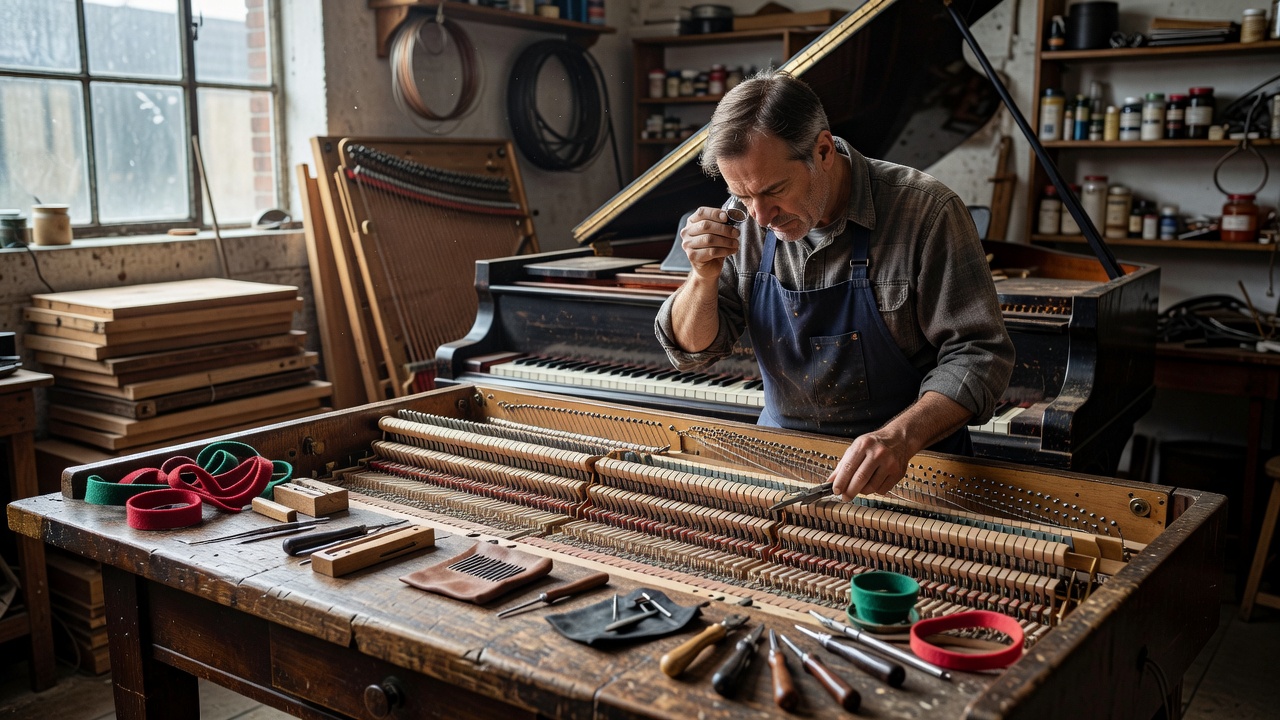
Document what survives
Record the maker, serial number, model markings and known ownership history. Photograph the instrument externally and, where safely accessible, its internal labels and components. Keep previous invoices and tuning records. A technician can distinguish ordinary wear from earlier modifications, incompatible replacement parts or structural repairs that deserve closer attention.
Documentation is especially important for unusual or historically significant pianos. Original hammer shapes, stringing patterns, action geometry and even workshop markings may hold information that disappears during replacement. A conservator may recommend preserving a component rather than making the instrument suitable for intensive performance. Not every historic piano should be forced into the role of a modern concert instrument.
Separate maintenance from reconstruction
Tuning, cleaning, regulation and modest repairs can produce substantial improvements when the underlying structure is sound. A piano with unstable tuning pins, seriously damaged bridges or extensive action wear may need a broader programme. These categories should come from examination and testing, not from a rule that every instrument of a certain age needs a new soundboard.
A soundboard crack is an observation, not a complete diagnosis. Its acoustic consequences depend on surrounding conditions, including rib attachment and whether unwanted noises occur. Similarly, a heavy touch might result from friction and regulation rather than requiring an entirely new action. Request evidence for each proposed intervention and ask what would happen if that intervention were postponed.
Replacement changes relationships
New hammers are not acoustically neutral substitutes. Their mass, dimensions, felt and placement interact with the action and string scale. Replacement action parts must suit the geometry rather than merely fit in the available space. Stringing and bridge work likewise demand a coherent plan. A successful rebuild considers these relationships instead of treating each component as an independent upgrade.
Some work is irreversible. Removing original bridge caps, replacing a soundboard or stripping a historic finish may eliminate evidence and alter the instrument’s character. That does not make such work automatically wrong. It means the reasons should be explicit and proportionate to the goal. A modern performance rebuild and a conservation treatment can both be thoughtful, while leading to different outcomes.
Commission with a written scope
A useful proposal identifies examination findings, included work, exclusions, materials, approval stages, transport responsibilities and aftercare. Ask how unexpected damage will be reported and authorised. Discuss where the piano will be stored and worked on, who carries responsibility during transport, and what written warranty applies. Compare proposals on their contents rather than their totals alone.
Allow for settling, tuning and regulation after the instrument returns to its room. Fresh work does not exempt a piano from humidity changes or ordinary maintenance. The final listening assessment should include your usual repertoire at different dynamics, not only a dazzling demonstration. Restoration can extend musical life, but no general article can promise a particular tone, resale value or lifespan for an unseen piano.
Sources and further reading
The Institute of Conservation explains professional conservation practice. The ICOM International Committee for Museums and Collections of Instruments and Music provides a museum perspective. Collections at the Horniman Museum and Gardens and the National Museums Scotland, including the work of the Edinburgh-based musical instrument collection, show why historical context matters. The Piano Technicians Guild is a useful starting point for service questions. These organisations are references, not endorsers of this website.
Before authorising tonal changes, also read Giving Sound a Room. The room may be responsible for part of the problem you are asking the restorer to solve.