What happens beneath a finger
A key is a lever, balanced around a fulcrum. As its front descends, its rear rises and moves a linked mechanism, commonly described through components such as the wippen, jack, repetition lever, hammer shank and hammer. Exact arrangements vary by design and period. The essential task is to translate finger movement into a controlled hammer velocity without leaving the hammer pressed against the string.
Escapement is the release that makes this possible. Shortly before the hammer reaches the string, the driving jack moves out of the way. The hammer completes its journey freely. After impact it rebounds, and the checking system helps control its return. The player can influence the hammer’s approach through the key, but cannot keep steering it after release as if drawing a bow across a string.
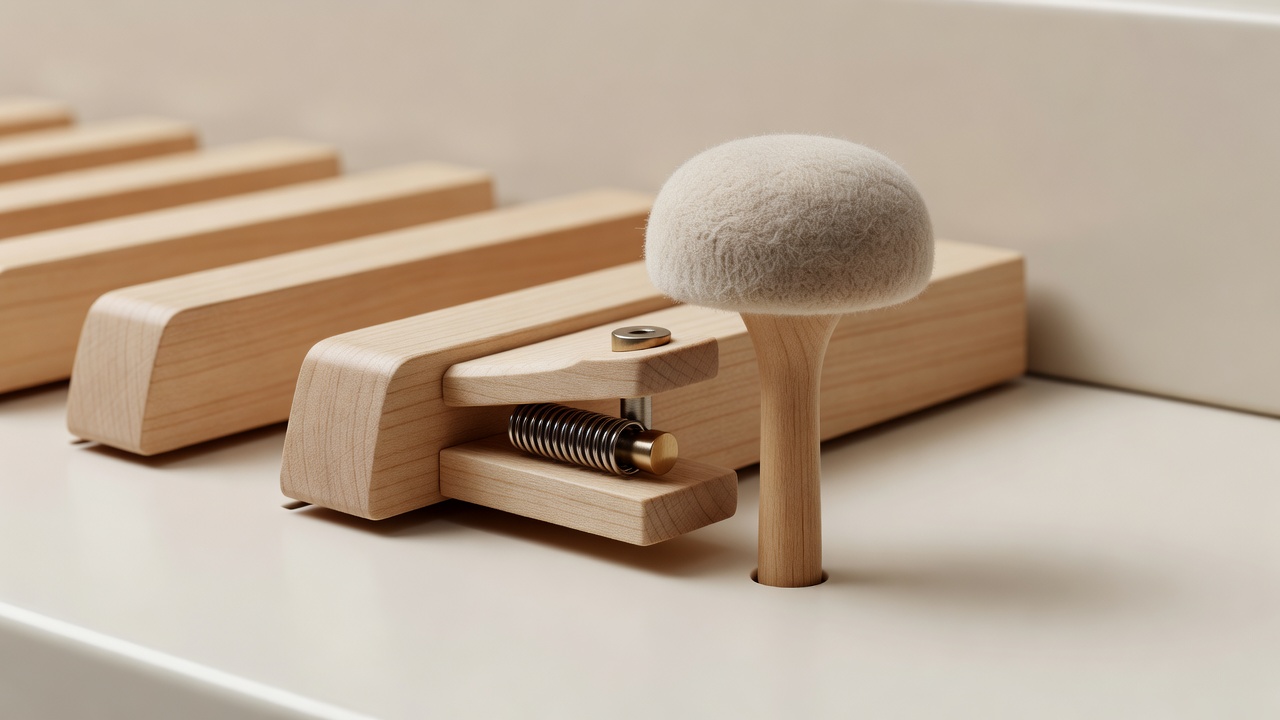
Repetition is a coordinated return
A modern grand action allows a note to repeat before the key has returned all the way to its resting position, provided the mechanism has recovered sufficiently. This capability is associated with developments by Sébastien Érard and later refinements. It is not an invitation to judge an action by the fastest possible repeated note alone. Reliable soft playing and control during ordinary musical passages are equally important.
A sluggish repetition can result from several interacting conditions: friction, worn components, poor spring adjustment, insufficient clearances or an unsuitable relationship between parts. Tightening one adjustment to disguise another problem can make the overall action worse. The technician’s work is therefore a sequence of checks, not a single secret setting that makes every piano fast.
Regulation is not tuning
Tuning concerns the pitches and relationships of the strings. Regulation concerns the geometry and timing of the mechanism. A regulator considers key level and travel, hammer travel, escapement, checking, repetition and damper operation, among other relationships. Changes are interdependent. Adjusting one point may require returning to an earlier stage to keep the whole action coherent.
Owners sometimes describe a piano as “heavy” when they mean tiring, slow or difficult to control quietly. Static downweight, measured under specified conditions, captures only part of the experience. Inertia, friction, leverage, key balance and the player’s movement also matter. A single gram figure is not a complete description of touch, and adding key weights without diagnosis can exchange one problem for another.
Voicing works with the hammer and the instrument
Voicing aims to shape tonal balance and progression, often through work on hammer felt and its contact with the strings. Hammer alignment, string condition and tuning should be considered first. A poorly fitted or badly worn hammer cannot always be made healthy through surface treatment. Needling and other interventions can permanently alter the felt, so they belong in trained hands.
A bright piano may be exciting in a large hall but tiring in a small reflective room. Before asking for a darker voice, listen with different lid positions and at several locations. Discuss the musical aim rather than prescribing a technique. A sensible voicing plan recognises the hammer’s remaining life, the scale design and the possibility that room treatment may address part of the complaint.
The pedals belong to the same conversation
The sustaining pedal raises dampers, allowing unplayed strings to participate sympathetically. Timing and damper seating influence clarity as well as silence. A grand piano’s una corda pedal shifts the action laterally; its effect depends on register, string grouping and the hammer surface meeting the strings. It is not simply an electronic volume control. Where fitted, the sostenuto mechanism selectively holds dampers already raised when it is engaged.
When evaluating an instrument, play familiar phrases at several dynamics, including soft chords and repeated notes. Test pedal releases slowly and musically. Ask permission before any unusual test, and never reach into a mechanism to “help” a reluctant part. If the piano is under consideration for purchase, arrange an independent inspection before deciding that ordinary regulation will resolve every concern.
Sources and further reading
The Piano Technicians Guild provides consumer information and professional context. Renner USA describes contemporary action components; its material reflects a component maker’s perspective. The Musical Instrument Museums Online catalogue helps locate historical instruments, including examples associated with Érard. Otto Ortmann’s The Physiological Mechanics of Piano Technique and Arthur A. Reblitz’s Piano Servicing, Tuning, and Rebuilding are established references with different aims. Neither replaces model-specific service information or an examination of your instrument.
When wear goes beyond routine preparation, move to the restoration chapter and separate a modest maintenance programme from substantial replacement work.